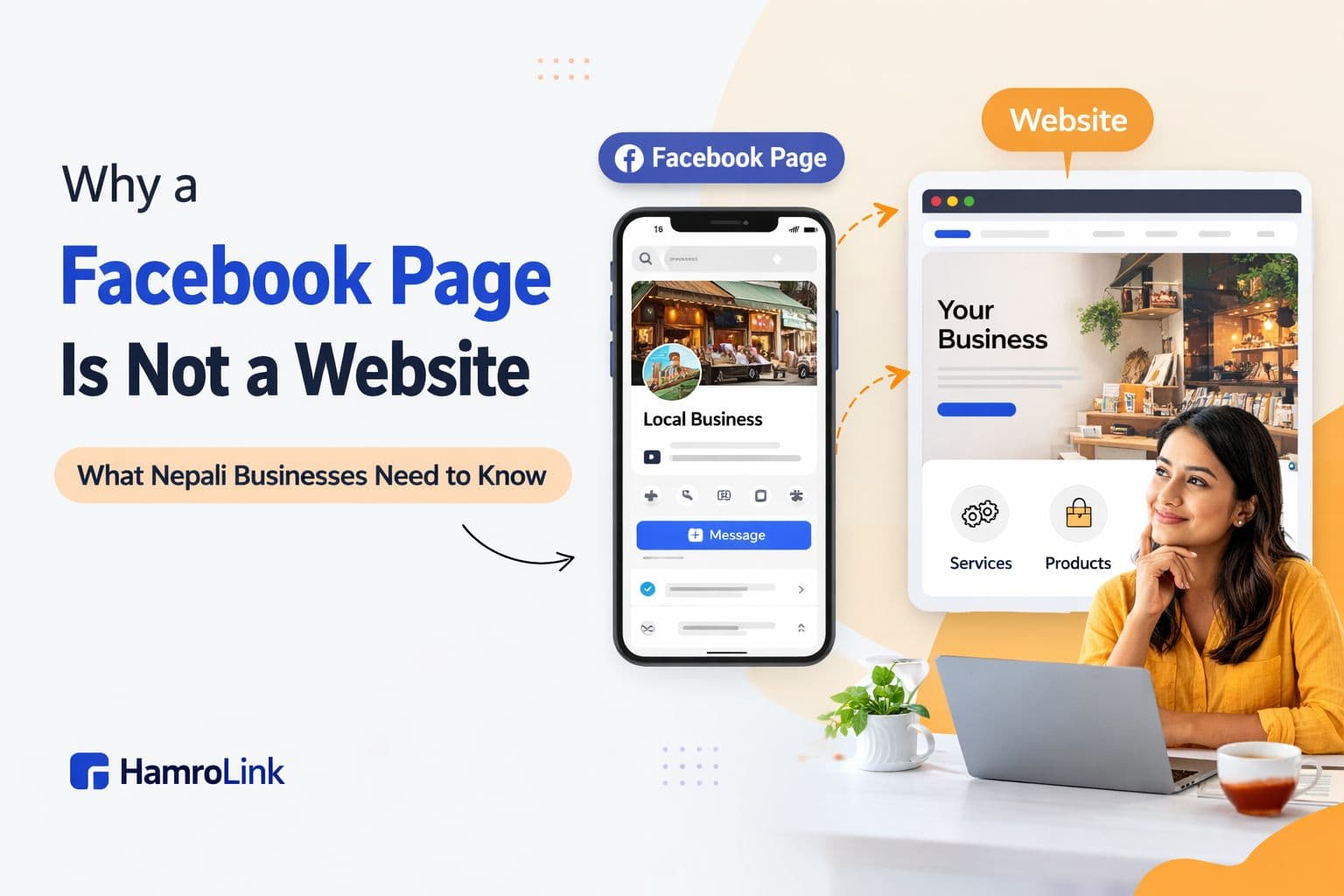
Why a Facebook Page Is Not a Website
In Nepal, many small businesses run almost entirely through Facebook. Restaurants post menus there. Clothing stores upload product photos. Freelancers promote their services through posts and messages. For many entrepreneurs, Facebook became the easiest way to get online.
But an important question often goes unnoticed: Is a Facebook page really enough for your business? While Facebook helps businesses reach people quickly, it cannot replace having your own website. Understanding the difference can help you build a stronger, more reliable digital presence — one that works for you 24 hours a day, even when you are not online.
Why Facebook Became the Default in Nepal
For many businesses in Nepal, Facebook was the first — and often only — step into the digital world. It is easy to understand why it became so popular.
Easy Setup
Creating a Facebook page takes only a few minutes. Businesses can upload photos, add contact information, write a description, and start posting immediately — all without spending a rupee. For a restaurant owner juggling cooking, staff, and customers, that simplicity is genuinely valuable.
Everyone Is Already on Facebook
Social media adoption in Nepal is very high, particularly on platforms owned by Meta. Nepal has over 14 million Facebook users as of 2024 — more than 45% of the population. Since customers are already there, businesses naturally followed. Why build something new when your audience is already somewhere?
No Technical Knowledge Required
Unlike traditional websites, Facebook pages require no coding, no hosting setup, and no design experience. For many business owners who never studied technology, this simplicity made Facebook the obvious choice. The barrier to entry was essentially zero — and that matters enormously for first-time digital entrepreneurs in Nepal.
The Problem With Relying Only on Facebook
While Facebook pages are genuinely useful, depending on them alone creates serious risks for your business. Here are the three biggest problems with a Facebook-only strategy.
You Don't Own the Platform
When your entire online presence depends on Facebook, you are building your business on land you do not own. Algorithms can change overnight — what reached 2,000 people last month might reach 200 next month. Post reach can drop without warning. Policies can update at any time, and accounts can be restricted, flagged, or permanently banned.
In 2021, a global Facebook outage took the platform offline for six hours. Every business whose only digital presence was Facebook simply vanished from the internet during that time. Because the platform belongs to Meta, businesses must always adapt to its rules — not the other way around.
Customers Can't Easily Find You on Google
Many customers begin their search online — not on Facebook, but on Google. When someone types 'best restaurant Thamel' or 'school admission Kathmandu 2026' into Google, the results show websites, not Facebook pages. Without a website, your business is simply absent from that search.
That means every potential customer who searches on Google — and that is millions of searches every day in Nepal — might never find you. They will find your competitor who has a website, instead.
Your Business Looks Less Professional
When customers research a business before making a decision — especially for services like schools, consultancies, clinics, or higher-value purchases — they expect to find a proper website. A website communicates services, products, contact details, pricing, and business information in a clear, organised way.
Businesses with websites consistently appear more established and trustworthy than those with only a Facebook page. In competitive categories, this perception gap directly translates to lost customers.
What a Website Gives Your Business
A website is not just an online brochure. For a Nepali business, it is a permanent digital asset that works 24 hours a day. Here is what you gain.
Full Control
You control the design, content, and exactly how customers experience your business online. No algorithm can limit who sees your page. No policy change can take away your content.
Search Visibility
Websites can appear in Google search results when customers look for services online. This means new customers discover you every day — for free, without any advertising spend.
Stronger Credibility
A dedicated website signals professionalism, stability, and seriousness. Customers trust businesses with websites more than those without — especially for high-value services.
Online Sales & Booking
Accept orders, reservations, and payments directly on your website via eSewa, Khalti, or bank transfer — 24 hours a day, even when your physical shop is closed.
Real Analytics
See exactly how many people visit your site, where they come from, and what they look at. Facebook gives vague 'reach' numbers — a website gives you real, actionable data.
One Professional Link
Share a single, branded URL (yourshop.hamrolink.com or yourdomain.com) on business cards, packaging, WhatsApp, and social media — a permanent address your customers always remember.
Side-by-Side: Facebook Page vs Website
Still unsure which matters more? See the full comparison below. The answer, as you will see, is that they are different tools designed for different jobs — and the strongest businesses use both.
The Best Strategy: Facebook + Website
The smartest digital approach for a Nepali business is not choosing between Facebook and a website. It is using both together — each doing what it does best.
Social media helps businesses reach audiences quickly, share timely updates, run promotions, and interact with customers in a conversational way. Facebook is excellent at building a community around your brand.
A website provides a stable, professional, searchable home base for your business. It is where customers land when they want to learn more, verify your legitimacy, or take a specific action — like placing an order, making a reservation, or getting directions.
In the most successful digital setups, the two platforms work as a funnel: social media attracts attention and awareness, while the website converts that attention into real customers and real revenue. Think of Facebook as the billboard on the road, and your website as the actual shop it points to.
"Facebook brings people to your door. Your website is the door."
— HamroLink
Making Websites Easier for Nepali Businesses
For many small businesses in Nepal, building a website has traditionally been expensive and complicated — custom development costs NPR 30,000–2,00,000 or more, and the technical complexity puts many business owners off before they even start.
That is one of the reasons we built HamroLink. HamroLink helps individuals and small businesses in Nepal create simple, professional websites without needing technical knowledge or large budgets. Choose from templates built for Nepali businesses — restaurants, schools, consultancies, shops, portfolios — fill in your details, and go live.
The goal is straightforward: help Nepali businesses move beyond social media alone and build a real, owned, searchable digital presence. With plans starting at NPR 399 and NPR 899 per month, getting your own website is now within reach for every business in Nepal.
Start Building Your Online Presence
If your business currently relies only on Facebook, now is a good time to expand your online presence. With a website, customers can discover your business on Google, learn about your services anytime, and contact you with confidence.
Join early access to HamroLink and start building your own website — no coding required, no large upfront cost, and no technical team needed.
Join Early Access — It's FreeFrequently Asked Questions
Everything Nepali business owners ask about Facebook pages vs websites.
Is a Facebook page enough for a business in Nepal?
A Facebook page helps businesses communicate with customers quickly and cheaply, but it does not replace a website. A website provides better search engine visibility, a more professional image, and a platform you fully own and control. For long-term growth, both are important.
Why do businesses still need websites if they have Facebook?
Websites allow businesses to appear in Google search results, provide detailed information about services, build long-term credibility, and capture customers who search online rather than scroll social media. Facebook reach is also limited by algorithms — your website is always there for anyone who looks.
Can small businesses in Nepal easily create websites today?
Yes. New platforms like HamroLink make it possible for any small business owner in Nepal to create a professional website in minutes — without coding, without hiring a developer, and without a large budget. Plans at NPR 399 (Starter) and NPR 899 (Pro) per month.
What is the main difference between a Facebook page and a website?
A Facebook page is a profile on a platform owned by Meta — you do not own it, and you must follow Meta's rules. A website is your own property on the internet. You control the design, content, domain name, and customer experience. Websites also rank on Google, which Facebook pages generally do not.
How do Facebook and a website work together for a Nepali business?
The best strategy is to use both. Facebook attracts attention — people discover you through posts, shares, and ads. Your website then converts that attention into real customers by providing detailed information, building trust, and making it easy to contact you or place an order. Think of Facebook as the billboard and your website as the shop.
Will having a website help me get found on Google?
Yes. Google indexes websites and can show them in search results when customers search for your type of business. A well-structured website with the right content can appear for searches like 'restaurant near me', 'school admission Kathmandu', or 'consultancy Nepal' — bringing you customers without any paid advertising.
You might also find helpful