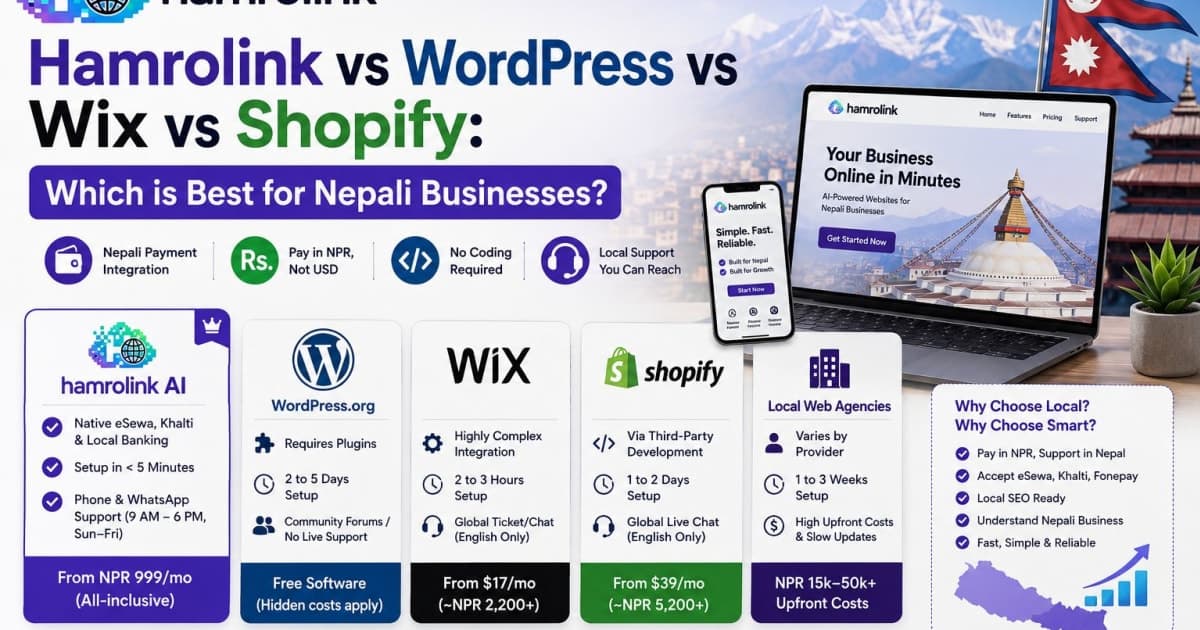
Hamrolink vs WordPress vs Wix vs Shopify: Which is Best for Nepali Businesses?
A bakery in Kathmandu, a visa consultancy in Itahari, and a clothing boutique in Pokhara all face the same core challenge: their customers are searching for them online first.
But trying to create a website in Nepal still feels confusing, expensive, and unnecessarily technical. Most global platforms expect international dollar cards, foreign payment setups, and English-only technical knowledge that small local businesses simply do not have time to learn.
Before diving into platforms, many business owners ask if a simple social page is enough. While social media is a great start, relying solely on it limits your growth—see our breakdown on Facebook Page vs Website for Nepali Businesses to understand why a dedicated domain matters.
To help you choose the right tool, we have analyzed the best website builder nepal options based on real costs, ease of use, local payment integration, and customer support.
What Makes a Website Builder "The Best" in Nepal?
Before you choose a platform to launch your site, look for these four essential features:
- Nepali Payment Gateway Integration: Your website must connect directly to eSewa, Khalti, or Fonepay so clients can buy products or book services easily.
- NPR Currency Options: You should be able to pay for your website subscription in Nepalese Rupees (NPR) without worrying about annual USD dollar card limits.
- A Website Without Coding: As a business owner, you don't have time to write code or wait weeks for an expensive web design agency.
- Accessible Customer Support: If your website has an issue during peak business hours, you need a support team you can actually call or message locally on WhatsApp.
If you are a local shop owner, your primary goal is driving foot traffic and local digital orders. Make sure your chosen platform natively supports local SEO optimization, which is crucial for ranking in near me searches in Nepal.
Quick Comparison Grid
| Platform | Local Payments (eSewa/Khalti) | Setup Speed | Support Type & Availability | Estimated Cost Baseline |
|---|---|---|---|---|
| Hamrolink AI | Natively Built-in | < 5 Minutes | Phone & WhatsApp (9 AM - 6 PM, Sun-Fri) | From NPR 999/mo (All-inclusive) |
| WordPress.org | Requires Plugins | 2 to 5 Days | Community Forums / No Live Support | Free Software (Hidden costs apply) |
| Wix | Highly Complex | 2 to 3 Hours | Global Ticket/Chat (English Only) | From $17/mo (~NPR 2,200+) |
| Shopify | Via Third-Party Dev | 1 to 2 Days | Global Live Chat (English Only) | From $39/mo (~NPR 5,200+) |
| Local Web Agencies | Varies by Provider | 1 to 3 Weeks | Phone & Email (Office Hours) | High Upfront Costs (NPR 15k-50k+) |
⏱️ Quick Decision Shortcut
- Want full control and custom coding? → Choose WordPress
- Want international e-commerce? → Choose Shopify
- Want a fast local business website with Nepali payments? → Choose Hamrolink AI
- Want a fully custom enterprise solution? → Hire a Local Agency
Deep-Dive Platform Reviews
1. Hamrolink AI: Best Overall Localized Builder
Hamrolink is built specifically for Nepalese entrepreneurs, creators, and small business owners who want a professional website without coding. It uses artificial intelligence to do the heavy lifting for you. The AI asks you a few simple questions about your business and creates a fully functional website instantly.
- 🎯 Best For: Local retail stores, consultancies, schools, restaurants, freelancers, and small e-commerce brands in Nepal.
- 🛑 Not Ideal For: Complex global SaaS applications or international-scale logistics platforms.
- The Good: Many small businesses in Nepal delay going online for months simply because traditional website creation feels too technical. Hamrolink removes that delay entirely. It features native eSewa, Khalti, and local banking options out of the box. For less than the monthly cost of a single boosted Facebook post (starting at NPR 999/month), you get your domain connection, hosting, and layout done. If you need help, you can call or text a local support team via phone or WhatsApp (9 AM to 6 PM, Sunday to Friday).
- The Bad: Because it is an automated AI platform, it is perfect for standard business sites and retail shops, but it is not designed for highly custom-coded software applications.
For retail businesses looking to sell online natively, you can read our complete walkthrough on how to create an ecommerce store with Hamrolink in Nepal. It cuts through the confusion of managing inventory and local shipping variables.
2. WordPress.org: Best for Complex Customizations
WordPress combined with the WooCommerce plugin is one of the most customizable ecommerce platforms available for users who want full control over their website’s code, hosting environment, and functionality.
- 🎯 Best For: Tech-savvy users, developers, or businesses that need deep, custom web features.
- 🛑 Not Ideal For: Absolute beginners or busy entrepreneurs who don't want to handle technical maintenance.
- The Good: The core software is free, heavily customizable, and has plenty of community-made plugins for local payment gateways like eSewa.
- The Bad (The Hidden Costs): While WordPress itself is free, the reality of a "free website" can quietly become very expensive over time. To keep a WordPress site running safely, you must pay for secure domain hosting, premium theme licenses, advanced SEO plugins, automated backup systems, and malware security tools. If a plugin updates and crashes your site, you either have to fix the code yourself or pay high developer maintenance fees to get it back online.
This technical complexity and fear of hidden maintenance fees is a major reason why Nepali businesses don't have websites in the first place.
3. Wix & Shopify: Best for International Brands
Wix is a visual drag-and-drop tool, while Shopify is a worldwide giant for online retail. If your business is targeting customers living in Western countries, these platforms are excellent.
- 🎯 Best For: Exporters selling handicrafts, clothes, or tea to international markets outside of Nepal.
- 🛑 Not Ideal For: Standard small business websites targeting local customers inside Nepal.
- The Good: They offer incredibly beautiful, world-class design templates and highly secure checkout systems for international credit cards.
- The Bad: They are expensive for a local startup. Wix starts around $17/month and Shopify starts at $39/month—and these prices quickly go up on renewal. Furthermore, connecting eSewa or Khalti requires advanced technical workarounds or hiring a developer to use custom webhooks. Their customer support teams are great, but they operate entirely in English on global time zones.
If you are managing specialized businesses like an educational institution or an agency, look for platforms that offer direct local frameworks rather than generic templates. For example, check out our guide on building a school website in Nepal or optimizing a Nepal consultancy website.
4. Traditional Local Web Agencies
Instead of using software, many companies prefer to pay a local web development agency to build a site from scratch.
- 🎯 Best For: Large enterprises, banks, and corporations that require unique database software architectures.
- 🛑 Not Ideal For: Small business owners who need to change prices, text, or photos on their site instantly without waiting for a middleman.
- The Bad (The Support Trap): Traditional agencies typically charge anywhere from NPR 15,000 to NPR 50,000+ upfront just to build a basic business website. Beyond money, traditional development also costs time—many businesses wait weeks or months just to launch or make simple revisions. Small changes like updating prices, uploading new notices, or changing banners often require contacting the developer again, waiting for their availability, and paying additional revision charges.
The Underrated Superpower: Why Local Support Matters
When evaluating a global website builder versus a local option, most people only look at features. They forget to look at what happens when something goes wrong.
If your international website shuts down due to a payment card issue or a broken template at 2:00 PM in Kathmandu, global customer support desks are often closed or backed up. You are forced to log a support ticket in English, talk to an automated chatbot, and wait for a response from a completely different timezone.
Having access to a localized support team that functions on Nepal Standard Time, communicates clearly in Nepali, responds instantly over WhatsApp, and thoroughly understands local business behaviors is a massive operational safety net for your brand.
Real-World Scenario: Do You Need Custom Coding?
Let's look at a practical example. A local educational consultancy in Dharan or a boutique in Lalitpur needs a website to show their services, display client testimonials, share a WhatsApp contact link, embed a Google Map location, and capture student inquiry forms.
In this scenario, paying a traditional web development agency a high website cost in Nepal (ranging from NPR 15,000 to NPR 50,000+ upfront) makes very little business sense. That budget is better spent on local marketing, while the website can be launched using an automated tool in minutes.
Direct Transparency: Who Should NOT Use Hamrolink?
Let’s be entirely honest: Hamrolink is not the perfect tool for every single project. Do not choose us if:
- You want total code ownership and zero monthly fees: If you want to buy a hosting package once, write or upload your own code, and never pay a software subscription fee again, you should choose WordPress.
- You are selling primarily to international customers: If your target buyers are in the US, Europe, or Australia, platforms like Shopify provide better native integrations for international shipping, global taxes, and foreign credit cards.
- You need a highly unique web application: If you are building a custom food delivery app, a massive property listing portal, or a complex social network, you should hire a traditional web development agency.
Understanding the Subscription Trade-off
Every modern website has ongoing costs—whether it is paying for individual hosting, domain renewals, security certificates, or premium payment plugins.
With WordPress, you pay for all of these pieces separately, often to different international companies in USD.
With Hamrolink, we bundle everything—your fast cloud hosting, domain connection, the AI builder tools, built-in eSewa/Khalti setups, and local phone support—into one transparent NPR monthly price.
Note on payments: If your business takes a break and you decide to stop your subscription, your website design and content stay safely saved in our system. The live website functionality will simply pause until you are ready to renew and turn it back on.
Conclusion & Next Steps
In 2026, having a website in Nepal is no longer optional for serious businesses. Whether you run a consultancy, retail store, school, restaurant, or service business, customers expect to find your information online instantly. The real question is no longer whether you need a website—but which platform gives you the best balance of affordability, simplicity, and long-term flexibility.
Summary: How to Choose Your Tool
- Choose WordPress if you want to build a highly unique website, have the technical skills to manage hosting, and have time to configure your own payment plugins.
- Choose Wix or Shopify if your target audience is international, you want to accept foreign credit cards, and you have a dollar card to pay the higher monthly USD subscription rates.
- Choose a Local Agency if you have a large upfront budget (NPR 20k+) and want a fully customized web application built completely by someone else.
- Choose Hamrolink AI if you want to launch a website today for less than the cost of a basic social media ad, pay locally in NPR, accept eSewa/Khalti out of the box, and want an easy, professional system you can manage yourself without a developer.
Ready to check out the tools that can grow your brand? Take a look at our complete Hamrolink Features list or find the perfect budget option on our Hamrolink Pricing page.
Comments
Be the first to leave a comment.