Part 1 – Before You Ask “How Much Does a Website Cost?”
Estimated reading time: 15 minutes
Who this guide is for – small business owners, startups, retail shops, restaurants, cafes, schools, colleges, consultancies, clinics, hospitals, and anyone planning a website in Nepal.
In 60 seconds
A website is one tool among many. It is not your business.
In 2026, customers expect more than a pretty homepage. They want to find you on Google, trust what they see, ask questions instantly, book appointments, buy products, pay digitally, receive updates, and get support after hours.
A website alone does not deliver all that.
So instead of asking “How much does a website cost?”, ask “What do I need to run my business online successfully?” This guide helps you answer both.
Why this guide exists
Search “Website Cost Nepal” and you’ll find dozens of articles. Most list three tiers – Basic, Business, E‑commerce – and stop.
That misses the real picture.
Imagine opening a restaurant. You would not ask “How much does a building cost?” because a building alone does not run a restaurant. You also need a kitchen, staff, tables, billing, inventory, marketing, and customer service.
A website works the same way. It gives customers a place to visit. Running your business online requires much more.
The mistake most businesses make
Many Nepali businesses follow the same path:
- Month 1: Build a website. Looks great.
- Month 3: Customers ask for online payment – add a gateway.
- Month 5: Inquiry forms fill up – where do you store customer data? Add a CRM.
- Month 7: Messages arrive at midnight – no one replies. Add a chatbot.
- Month 10: You want repeat customers – add email marketing, promotions, segmentation.
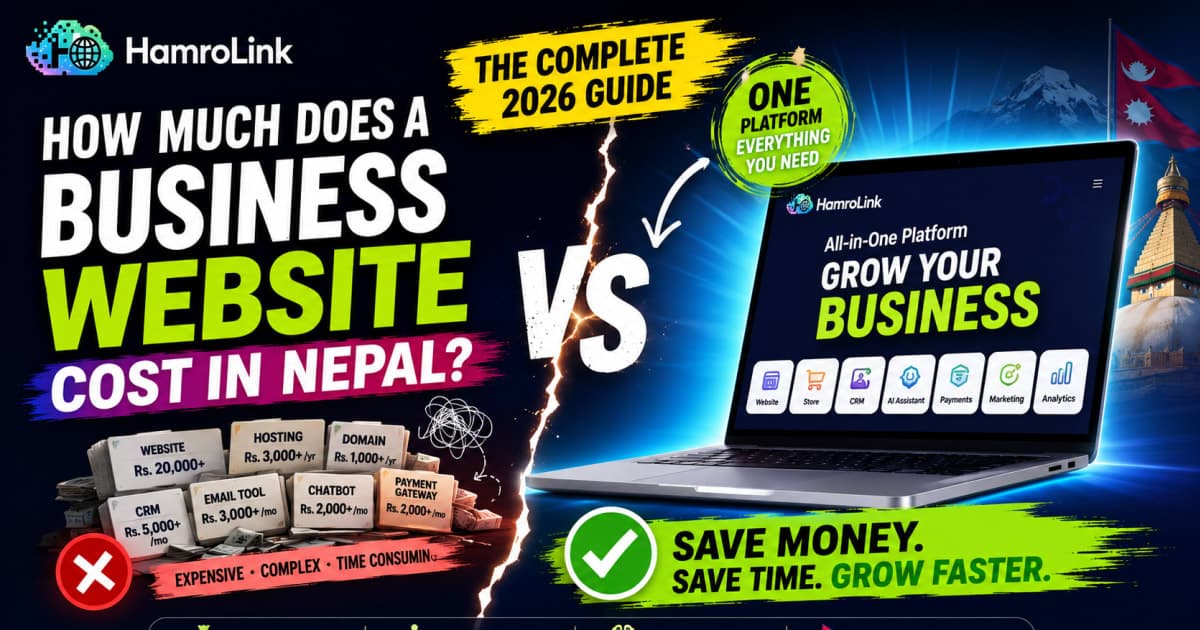
- Month 12: You now pay separate providers for hosting, domain, CRM, email software, chatbot, booking, payment gateway, analytics – each with different logins, invoices, support teams, and update cycles.
The website itself was not expensive. The ecosystem became expensive.
The question nobody asks
Instead of “How much does a website cost?” ask:
“What will my business need one year from now?”
Choosing the wrong foundation today often means rebuilding everything later. A little planning can save thousands of rupees and countless hours of migration.
Website vs. business
A website is what people see. A business is what runs. Those are different.
Your customers do not care whether your site uses WordPress, React, or something else. They care whether they can find information quickly, contact you easily, get answers without waiting, buy or book without friction, and trust you.
Technology is useful only when it improves those customer experiences. Successful businesses focus less on the tech itself and more on what it enables customers to do.
Five jobs every digital business must do
Regardless of industry, every online business needs to accomplish these five things:
- Be found – through your website, Google Search, SEO, Google Business Profile, and blog content.
- Build trust – with professional design, reviews, portfolio, clear service info, fast loading, and a secure site.
- Convert visitors – into inquiry forms, calls, messages, bookings, purchases, or payments.
- Manage customer relationships – track details, inquiries, orders, appointments, follow‑ups, and purchase history.
- Grow automatically – automate repetitive tasks: answering common questions, sending follow‑up emails, welcoming new customers, requesting reviews, reminding appointments, recovering abandoned carts, and running campaigns.
What happens after launch?
A business spends NPR 30,000, 80,000, or even 2,00,000 on a website. It launches. Everyone celebrates. Then… nothing changes. No more customers, no more sales.
The site is not broken. It is simply not connected to the rest of the business.
Think of a physical shop: unlocking the door does not guarantee customers will walk in, buy, and return. The same applies online.
A customer journey example
It is 9:47 PM. Someone searches “best consultancy in Kathmandu” and finds your site.
Scenario A – They have one question: “Do you process UK student visas?” Your office is closed. The contact form says “We’ll get back to you.” By morning they have contacted three competitors. You never even knew they visited.
Scenario B – An AI assistant replies instantly. It answers common questions, collects their name, phone number, destination country, and preferred intake. The inquiry is saved. Tomorrow morning your team knows exactly who the customer is before the first call.
The website did not just display information – it started working.
That is the difference: a website shows information; a business system moves customers forward.
The five pillars, simply
| Business goal | What helps achieve it |
|---|---|
| Be found | Website, SEO, blog, Google |
| Build trust | Professional design, testimonials, portfolio |
| Convert visitors | Forms, AI assistant, online payments |
| Manage customers | CRM, customer database |
| Grow automatically | Email marketing, automation, analytics |
This framework works regardless of platform or developer.
The cost of piecemeal tools
Most businesses buy tools only after a problem appears. First a website, then payments, then booking, then CRM, then email, then chatbot. Each new requirement becomes another subscription, login, dashboard, and support contact.
None of those decisions are wrong individually. But over time, complexity grows faster than the business.
A better approach: ask “What systems will I need over the next three years?” If you know you will eventually need payments, CRM, AI assistance, marketing, booking, and analytics, it often makes sense to choose a platform that can grow with you – rather than rebuilding every time you reach the next stage.
Not every business needs everything from day one. A small local shop may only need a simple site. A growing consultancy may need CRM soon. A school may eventually need admissions, results, and parent communication. The key is choosing a foundation that does not force you to start over.
From websites to AI Business Operating Systems
A decade ago, the question was “Can I get a website?” Today it is “How much of my business can technology run for me?”
Businesses have gone through several digital eras:
- No online presence – customers found you via referrals or foot traffic.
- Social media – Facebook and Instagram became storefronts, but you did not own the audience; algorithms changed and reach dropped.
- Business website – you controlled your brand and could be found on Google.
- Business platform – you added CRM, email, booking, payments, analytics, live chat. Now the business worked, but complexity grew.
The next step is an AI Business Operating System – a single platform that manages the entire customer journey:
- Build – launch websites, landing pages, blogs, forms, and SEO without hiring separate designers and developers.
- Sell – customers browse, order, pay, and receive invoices within one ecosystem.
- Manage – every inquiry becomes a customer record, orders and leads stay connected, history lives in one place.
- Automate – AI answers common questions, qualifies leads, sends follow‑ups, recommends products, reminds customers – 24/7.
- Grow – see where visitors come from, what converts, which products perform, which campaigns work, which customers return. Growth becomes measurable, not guesswork.
Where HamroLink fits
This is the direction HamroLink is being built around – not just another website builder, online store, or CRM, but an AI Business Operating System for Nepali businesses.
The idea is simple: instead of buying five or ten separate tools, manage everything from one platform. Today that includes professional websites, blogging, SEO, online stores, eSewa/Khalti/Fonepay integration, CRM, lead management, forms, AI assistant, email marketing, automation, and analytics.
As AI evolves, the goal is not just helping businesses create websites – it is helping them automate daily operations so owners spend less time on repetitive work and more time on decisions that grow the business.
The real cost is not building a website
Many businesses spend weeks comparing quotes – NPR 20,000, 40,000, 80,000, 1,50,000. After launch, they discover they still need customer management, marketing, payments, follow‑up, automation, and analytics.
The website was only the starting point.
That is why the smartest question in 2026 is not “How much does a website cost?” but “What system will help my business grow over the next five years?” Technology is becoming the operating system that quietly works behind your business every day.
What should you actually choose? (And when?)
Your choice depends on where your business is today and where you expect it to be in a few years.
-
Just starting – a new clothing store, consultancy, café, or salon. Priorities: being found on Google, looking professional, building trust, easy contact. A professional website with SEO and contact forms is usually enough – but check whether it can grow with you.
-
Selling products – customers expect to browse, search, add to cart, pay online, receive confirmations, track orders. Behind the scenes you need product, inventory, customer, order, and payment management. Buying these separately becomes expensive. A connected platform simplifies everything.
-
Service business – consultancies, law firms, accountants, architects, agencies, freelancers. You need lead generation and management. The customer journey – search, visit, read, ask, book, follow‑up, convert – matters more than flashy design.
-
School or educational institution – beyond a public site, you may need admissions, online inquiries, result publishing, notices, events, student communication, document downloads. A platform that understands education workflows can reduce cost and complexity.
-
Clinic or healthcare practice – patients expect appointment booking, asking questions, reminders, location, quick contact. Reliability is critical – uptime, backups, security, scalability matter as much as design.
-
Already growing – many businesses buy a basic site, then six months later need CRM, payments, email, chatbot, automation, analytics. Instead of growing naturally, they start replacing tools, migrating data, and learning new systems again and again. If you know you will eventually need these capabilities, a platform that grows with you is often cheaper than rebuilding every few years.
Freelancer vs agency vs AI Business Operating System
| If you need… | Best choice |
|---|---|
| A simple brochure site with a fixed budget | Freelancer |
| A fully custom enterprise solution | Agency |
| A complete digital business platform that grows with you | AI Business Operating System |
None is universally better. Match the solution to your business, not just the cheapest quote.
A simple decision framework
Before spending, ask yourself:
✅ Do I only need information online?
✅ Will I eventually sell online?
✅ Do I need customer management?
✅ Will I need online payments?
✅ Do I want instant customer responses?
✅ Will I run marketing campaigns?
✅ Will my business grow over the next 3–5 years?
The more “yes” answers, the more value an integrated platform provides.
Final thoughts
When people ask “How much does a website cost in Nepal?” they are really asking “What is the smartest investment for my business?”
A website is important. But it is not the destination – it is the foundation.
The businesses that grow over the next decade will not just have better‑looking websites. They will have better systems – for discovery, trust, conversion, relationship management, automation, and continuous improvement.
That is why the conversation is shifting from websites to digital business platforms, and now to AI Business Operating Systems.
Whether you choose a freelancer, an agency, or an all‑in‑one platform, do not evaluate it only by today’s requirements. Ask:
- Will this still support my business in three years?
- Will it grow with me?
- Will it save time every day?
- Will it help me serve customers better?
The cheapest website is not always the best investment. The most expensive is not always the smartest. The best choice is the one that continues creating value long after your website goes live.
Ready to build more than just a website?
If you are looking for a platform designed for Nepali businesses, explore what an AI Business Operating System looks like in practice.
HamroLink brings together the tools businesses often buy separately – professional websites, SEO, blogging, online stores, local payment integrations, CRM, lead management, AI assistance, email marketing, automation, and analytics – into one platform that grows with your business.
Whether you are launching your first website or planning your next stage of digital growth, start by thinking beyond the website itself. The right foundation today can save significant time, money, and complexity tomorrow.
Comments
Be the first to leave a comment.