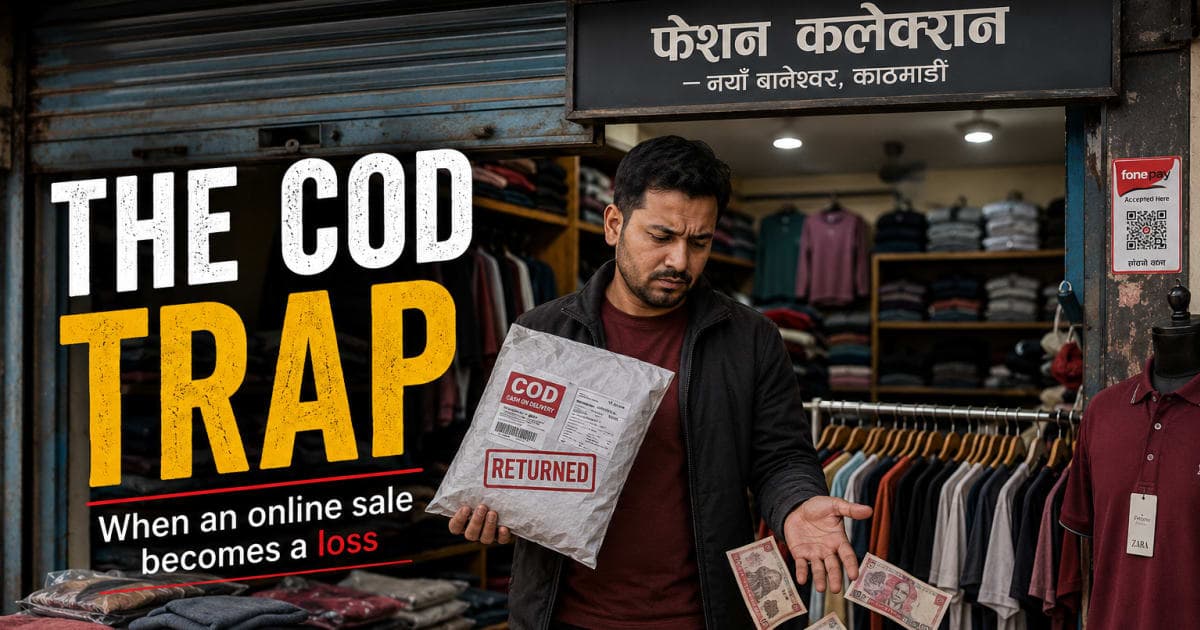
If you sell clothes, gadgets, cosmetics, or lifestyle products online in Nepal, you already know the sinking feeling.
You pack a parcel in Kathmandu, hand it over to a courier heading to Pokhara, Biratnagar, or Butwal, wait several days, and then get the update:
“Delivery Failed — Customer Unreachable.”
Or worse:
“Customer Cancelled at Doorstep.”
Most conversations about e-commerce growth in Nepal focus on getting more orders — running Facebook ads, posting Reels, chasing reach.
But for a lot of small online sellers, the real leak isn't order volume. It's what happens after the order is placed.
The parcel goes out. The seller pays for shipping. The customer doesn't receive it. The parcel comes back. And the seller is left with the shipping cost, return cost, packaging cost, advertising cost, and an item that spent days sitting in transit instead of being sold.
That's the COD trap.
Cash on Delivery (COD) is widely described as the default payment method in Nepali e-commerce. There isn't a robust national survey that pins the exact share down to a specific number, so this article won't pretend there is one.
But the pattern is familiar to sellers, couriers, and e-commerce platforms: many Nepali buyers still prefer paying when the parcel arrives rather than paying in advance.
COD makes buying easier for the customer.
It also moves more of the risk onto the seller.
Every rejected parcel can mean you've already paid for outbound shipping, and in many cases you'll pay again for the return leg. Meanwhile, the product is tied up in transit and unavailable for another customer.
This article looks at what a failed COD order can actually cost, why these failures happen, and what small online sellers can do to reduce them without abandoning COD altogether.
The Real Math: What a Failed Delivery Actually Costs
Let's look at a simple example.
Suppose you sell a fashion item for NPR 2,000.
| Item | Amount |
|---|---|
| Product sourcing cost | NPR 1,200 |
| Gross margin per item | NPR 800 |
| Marketing / ad spend per order | NPR 200 |
| Outbound courier charge (outside valley) | NPR 150 |
| Net profit on a successful delivery | NPR 450 |
The customer receives the product, pays NPR 2,000, and you've made roughly NPR 450 after these costs.
Now consider the same order when the customer refuses the parcel at the doorstep.
| Item | Amount |
|---|---|
| Outbound courier charge | NPR 150 |
| Return-to-origin (RTO) charge — illustrative | NPR 90 |
| Wasted ad spend | NPR 200 |
| Packaging and handling | NPR 50 |
| Approximate loss on failed delivery | NPR 490 |
The NPR 90 RTO figure is only an illustration. Couriers don't publish one universal RTO percentage, and the actual amount can vary by courier, route, and merchant agreement.
The important part isn't whether your RTO fee is NPR 90, NPR 75, or something else.
It's the relationship between the two numbers.
You might make NPR 450 from a successful order, while a failed order can cost you around NPR 490.
So one failed delivery can wipe out most or all of the profit from a successful sale.
And that is before considering the opportunity cost of having your inventory stuck in transit.
What Rising Return Rates Do to Your Bottom Line
Instead of pretending there is one “average” COD return rate for Nepal, look at what different failure rates would do to the same batch of orders.
Using the numbers above:
| Metric | 0% returns | 10% returns | 20% returns | 30% returns |
|---|---|---|---|---|
| Orders dispatched | 10 | 10 | 10 | 10 |
| Successful deliveries | 10 | 9 | 8 | 7 |
| Gross profit from delivered items | NPR 8,000 | NPR 7,200 | NPR 6,400 | NPR 5,600 |
| Ad spend | NPR 2,000 | NPR 2,000 | NPR 2,000 | NPR 2,000 |
| Outbound delivery fees | NPR 1,500 | NPR 1,500 | NPR 1,500 | NPR 1,500 |
| RTO + packaging/handling on failed orders | NPR 0 | NPR 140 | NPR 280 | NPR 420 |
| Net take-home profit | NPR 4,500 | NPR 3,560 | NPR 2,620 | NPR 1,680 |
The pattern is what matters.
At 0% failure, this batch produces NPR 4,500.
At 30% failure, it produces only NPR 1,680.
The seller still created the same ads. The seller still packed 10 parcels. The seller still paid for 10 outbound shipments.
The difference is what happened after those orders were placed.
That's why looking only at order volume can be misleading.
If you get 100 orders but 30 of them come back, those 100 orders aren't worth the same as 100 successful deliveries.
Your own numbers will be different. Plug your actual product margin, ad spend, courier fees, and failed-delivery rate into the same calculation. That's a much better measure of your business than an industry-wide “average.”
Why COD Orders Fail in Nepal
Failed deliveries rarely happen for just one reason.
A few recurring habits in informal social selling make the problem worse.
Impulse Messenger and Comment Ordering
A customer comments:
“Price?”
Then:
“Send one size L.”
Then you ask for an address, take a phone number, and ship the parcel.
The entire purchase can happen without the customer ever going through a proper checkout.
There's no structured order summary. No clear delivery information. Sometimes there's not even a proper confirmation.
The customer may genuinely want the product when they place the order.
But several days later, that urgency may be gone.
Maybe they found another product. Maybe they spent the money somewhere else. Maybe they simply forgot about the order.
The seller, meanwhile, has already shipped it.
Vague Addresses
“New Road, Pokhara.”
“Near Hospital, Butwal.”
“Baneshwor.”
These might be familiar places to a human who lives nearby. They aren't necessarily enough information for a delivery rider trying to find one specific customer.
A ward number, tole, nearby landmark, and a reachable phone number can make a big difference.
When the address is incomplete and the customer doesn't answer the phone, a delivery attempt can quickly turn into an RTO.
Sizing and Expectation Problems
This is especially common with clothing, footwear, cosmetics, and other products where expectations matter.
A social media post might show a product beautifully but leave out important details:
- Actual measurements
- Material
- Available sizes
- Product dimensions
- Color differences
- What is included in the package
The customer sees one thing online and expects another at the doorstep.
With COD, they have an easy way out: they can simply refuse the parcel.
Long Delivery Times
The longer a customer waits, the more opportunities there are for the order to fall apart.
Maybe they needed the item for an event that has already passed.
Maybe they found another seller.
Maybe they aren't available when the courier arrives.
Maybe they simply forgot they ordered it.
This is particularly important for out-of-valley orders where delivery can take longer than customers expect.
A customer who knows when the parcel is coming is easier to manage than a customer who has no idea whether the order has even been dispatched.
Five Practical Steps to Reduce COD Delivery Failures
You don't need to eliminate COD to fix this.
You need to manage it better.
The goal isn't to make every customer jump through hoops. It's to identify unclear or low-intent orders before you spend money sending them across the country.
Step 1: The 2-Hour Confirmation Protocol
Don't dispatch a COD parcel straight from an unconfirmed comment or DM.
Try to confirm the order while the customer's buying intent is still fresh.
Confirm quickly
Contact the customer within a couple of hours whenever possible.
You don't need a long conversation.
Just confirm the important details.
Verify four things
1. Product details
Confirm the exact product, size, color, quantity, and total amount.
2. Delivery address
Ask for:
- Municipality
- Ward number
- Tole
- Nearby landmark
- Full recipient name
For example:
Ward 4, Shanti Nagar, near Siddhartha Bank ATM.
That's much more useful to a rider than simply “Shanti Nagar, Pokhara.”
3. Phone number
Make sure the primary number is correct.
For higher-risk orders, you can also ask for a backup contact method such as WhatsApp.
4. Delivery readiness
Tell the customer when they can expect delivery and how much they need to pay.
For example:
“Your order is NPR 2,000. We'll dispatch it today and the courier should reach you in 2–3 business days. Please keep the amount ready.”
That simple message can prevent a surprising number of misunderstandings.
Use a simple two-strike rule
If a customer is unreachable after two attempts over 24 hours, don't immediately send the parcel anyway.
Send one final message asking them to confirm the order.
If there is still no response, cancel the order and return the product to available inventory.
It's better to lose an uncertain order before dispatch than to pay to send it across the country and bring it back.
Step 2: Make Upfront Digital Payment the Easy Choice
You don't have to force every customer to prepay.
Give them a reason to choose it.
For example:
- NPR 100 off for prepaid orders
- Free delivery for prepaid orders
- A small discount on selected products
- Priority processing for prepaid orders
If a returned COD parcel can cost you several hundred rupees, giving a serious customer NPR 100 off for paying upfront may be cheaper than taking the risk.
You can also consider a small advance for certain orders.
For example, for an expensive product or a shipment going far outside the Valley, you might request NPR 100–200 upfront through a digital payment method and collect the remaining balance on delivery.
A token advance doesn't guarantee delivery, but it creates more commitment and can filter out some low-intent orders before they are shipped.
The important part is to make the policy clear.
Don't surprise the customer with an advance-payment requirement after they've already placed the order.
Step 3: Replace DM Chaos With a Structured Product Page
Social media is excellent for discovery.
It isn't always the best place to manage the entire transaction.
When the product information lives in a Facebook post, Instagram caption, Messenger conversation, and someone's notebook, mistakes become almost inevitable.
A proper product page gives the customer one place to check everything before ordering.
For clothing and footwear, include:
- Measurement charts
- Sizes available
- Measurements in inches and centimeters
- Material information
- Multiple product photos
- Clear information about colors and variations
For other products, show the specifications that actually affect the buying decision.
Also make delivery information easy to find.
Tell customers:
- Where you deliver
- Expected delivery time
- Delivery charges
- Payment options
- Return or exchange conditions
Clear information doesn't just look professional.
It reduces the number of things a customer can misunderstand before placing an order.
Step 4: Automate Order Updates
One of the easiest ways to reduce uncertainty is simply to communicate.
The customer shouldn't have to message you:
“Dai, mero order kaha pugyo?”
every few days.
A basic order communication flow can include:
Immediately after ordering
Send an order confirmation with:
- Order number
- Products
- Quantity
- Total amount
- Delivery address
- Payment method
When dispatched
Send the tracking number as soon as the courier receives the parcel.
On delivery day
Send a short reminder:
“Your order is out for delivery today. Please keep NPR 2,000 ready and keep your phone available for the courier.”
These aren't complicated messages.
But they keep the order alive in the customer's mind.
Step 5: Track Repeat Offenders
Not every customer deserves the same level of trust forever.
If a phone number has repeatedly placed COD orders and rejected them, record that history.
When the same customer orders again, you can choose to require full prepayment before dispatch.
At the same time, don't treat every customer as a potential problem.
If someone has successfully received five or ten COD orders from you, that customer has already demonstrated reliability.
You can prioritize their orders, offer faster fulfillment, or continue offering COD without an additional deposit.
Trust should work both ways.
Where a Tool Like HamroLink Fits In
Most of the fixes above are process, not software.
You still need to confirm orders.
You still need accurate product information.
You still need to communicate with customers.
But a structured storefront makes those processes much easier to follow consistently.
That's where I built HamroLink to fit.
A HamroLink store can bring the important parts of the workflow into one place: product catalogs, structured checkout information, local payment options, delivery charges, and order history.
For an online seller, that means things like:
- Product pages where customers can see product information before ordering
- Sizing and product details instead of relying entirely on DMs
- Structured checkout fields for delivery information
- Local payment options such as eSewa, Khalti, and Fonepay QR
- COD alongside digital payment options
- Order history so you can see previous customer activity
- Delivery information and order status in one place
The point isn't that putting your business on a platform will magically eliminate failed deliveries.
It won't.
The discipline in the five steps above is still what makes the difference.
A platform simply makes that discipline easier to maintain when you're dealing with dozens or hundreds of orders instead of five orders a week.
Pre-Dispatch Checklist
Before your next batch goes to the courier, take a minute to check each order:
- Is the recipient's number verified through a confirmation call or message?
- Does the address include the ward number, tole, and a recognizable landmark?
- Has the customer confirmed the exact product, size, color, and total amount?
- For high-value or out-of-valley orders, was a prepayment incentive or deposit considered?
- Is the order and tracking information recorded for monitoring?
A five-minute check before dispatch can be cheaper than dealing with a returned parcel several days later.
The Number That Actually Matters
Getting more orders feels like growth.
But orders are only the beginning.
If you're spending NPR 200 to acquire an order, NPR 150 to ship it, and then losing another few hundred rupees when the customer refuses it, your advertising dashboard can look great while your bank balance tells a completely different story.
That's why COD management deserves more attention from Nepali online sellers.
You don't need to stop offering COD.
You need to know which orders are ready to ship, which customers need confirmation, and where you're repeatedly losing money.
Start tracking three numbers every month:
Orders placed → Orders successfully delivered → Orders returned or cancelled
Then calculate how much each failed order actually costs your business.
Once you know that number, reducing failed deliveries stops being a vague operational problem.
It becomes a profit problem you can measure and improve.
A note on the numbers: The unit-economics figures in this article are modeled examples for illustration, not verified averages across Nepali sellers. Actual costs vary by product, courier, route, advertising channel, and merchant agreement. Nepal does not currently have a widely available national dataset covering COD share and RTO rates across online sellers, so this article avoids presenting an industry-wide failure rate as fact. If you have your own delivery and return data, use your actual numbers — they will tell you much more about your business than a generic industry average.
Comments
Be the first to leave a comment.