Can you sell products online in Nepal without Daraz?
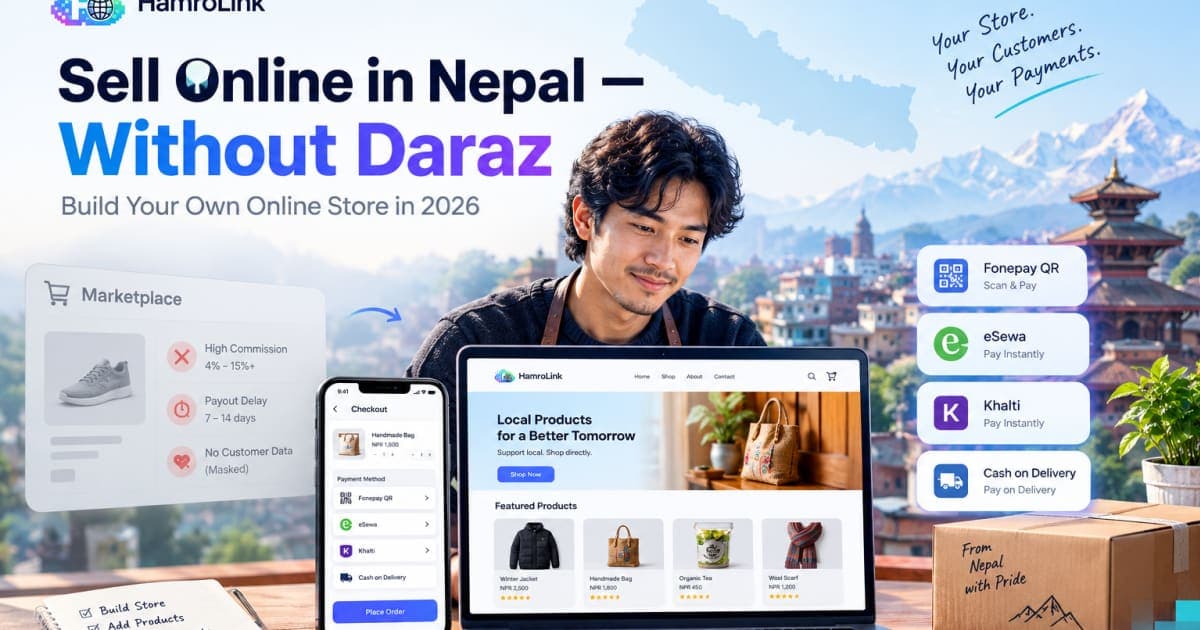
Yes. Nepali businesses can sell directly to consumers by launching an independent online store integrated with local payment options like Fonepay QR, eSewa, Khalti, and Cash on Delivery (COD). By using a localized, zero-code platform like HamroLink, merchants eliminate 4%–15%+ marketplace commissions, receive customer payments directly into their bank accounts without escrow delays, and retain full ownership of customer contact data for repeat sales.
Key Takeaways
- Escape Commission Drag: Marketplace fees, category commissions, and return charges can consume 15% to 30% of gross margins on marketplace platforms.
- Direct Cash Flow Velocity: Direct QR and digital wallet payments settle immediately into your own bank account, eliminating 7-to-14-day marketplace payout holds.
- Own Your Customer Database: Unlike marketplaces that mask buyer contact info, an independent storefront lets you build a real CRM to drive repeat Dashain, Tihar, and seasonal sales.
- Zero-Code Simplicity: Modern platforms tailored for Nepal eliminate the need for expensive web agencies (NPR 30,000–80,000) or USD-billed international SaaS that depletes your national $500 foreign currency card limit.
1. The Marketplace Dilemma: Why Nepali Sellers Are Looking Beyond Daraz
For years, Daraz has served as the default starting point for e-commerce in Nepal. As the country's largest digital marketplace, it provides instant access to catalog traffic and established buyer trust. However, as independent brands, local manufacturers, and boutique retailers mature, many discover that marketplace dependency introduces structural bottlenecks that hinder long-term profitability.
1.1 The Cumulative Toll of Marketplace Fees
Marketplace selling appears low-friction until sellers calculate their net margins at the end of the month. Selling on a third-party marketplace typically incurs multiple stacked costs:
- Category Commissions: Varying widely from roughly 4% up to 15%+ depending on the merchandise category (consumer electronics generally sitting lower, while fashion, beauty, and lifestyle sit on the higher end).
- Payment Processing & Gateway Fees: Standard 1.5% to 2.5% cuts on electronic transactions.
- Value Added Tax (VAT) on Services: Applicable on platform service and fulfillment charges.
- Mandatory Packaging Materials: Specialized branded packaging requirements for hub drop-offs.
- Paid Visibility (PPC Ads): As marketplace catalogs swell with competing sellers sourcing similar inventory, organic reach declines. Sellers increasingly must buy sponsored keyword ads inside the marketplace app simply to maintain sales velocity.
1.2 Payout Escrow and Working Capital Constraints
Cash flow is the lifeblood of small and medium-sized enterprises (SMEs) in Nepal. On third-party marketplaces, customer payments are held in platform escrow until orders are marked delivered and dispute periods lapse. Settlement cycles commonly run weekly or bi-weekly. For a merchant operating on tight inventory turnaround, having capital tied up for 10 to 14 days makes restocking and supplier negotiations difficult.
1.3 Rented Land: The Masked Customer Problem
The most severe long-term limitation of marketplace selling is that you do not own your customer relationships.
Under marketplace privacy policies, buyer phone numbers and email addresses are masked or withheld. All communications must happen inside the platform's chat ecosystem. When festive seasons like Dashain, Tihar, or New Year approach, you cannot export your past buyer list to send a direct promotional SMS, an email announcement, or a WhatsApp VIP discount. Every sale requires re-acquiring the customer from scratch.
2. The Three Ways to Sell Online in Nepal: A Comparison
Nepali entrepreneurs generally operate across three distinct digital selling models. Understanding the trade-offs is essential to picking the right operational stack.
| Evaluation Metric | Third-Party Marketplace (e.g., Daraz) | Social Media DMs (Instagram / Facebook / TikTok) | Independent Owned Store (e.g., HamroLink) |
|---|---|---|---|
| Setup Cost | Low (Free account creation) | Free (Page / Account setup) | Low / Free tier (NPR 0 to NPR 199/month) |
| Sales Commission | 4% to 15%+ per transaction | 0% | 0% Commission |
| Payment Options | Controlled by marketplace | Manual screenshot verification via personal wallet/bank | Native Fonepay QR, eSewa, Khalti, & COD |
| Payout Velocity | 7 to 14 days (Escrow hold) | Direct (instant to personal wallet/bank) | Direct to your business bank account |
| Order Management Effort | Medium (Portal packaging & dispatch) | Extremely High (Manual "Inbox for Price" chat negotiation) | Automated checkout & instant invoice creation |
| Customer Data Ownership | Zero (Masked by platform) | Minimal (Unstructured social chats) | 100% Owned CRM Database |
| Google Search Visibility | Platform ranks; seller doesn't | Low / Negligible | High (Dedicated domain & indexed product pages) |
| Brand Equity | Low (Buyer says "I bought it on Daraz") | Medium (Social visual branding) | High (Your own brand domain & store identity) |
3. Unit Economics Breakdown: Marketplace vs. Independent Store
To understand how channel selection alters profitability, consider an illustrative unit economics model for a popular lifestyle/apparel product retailing at NPR 2,000.
Disclaimer: The figures below represent a hypothetical scenario based on standard category benchmarks in Nepal (assuming a 10% marketplace commission, 2% payment processing, standard Kathmandu Valley courier delivery, and an illustrative return reserve). Actual margins depend heavily on your specific product category, supplier sourcing costs, packaging, and return frequency.
Unit Economics Comparison Table (NPR 2,000 Retail SKU)
| Cost Breakdown Line Item | Marketplace Channel (NPR) | Independent Owned Store (NPR) | Variance Analysis & Rationale |
|---|---|---|---|
| Retail Selling Price | NPR 2,000 | NPR 2,000 | Identical retail price point to customer. |
| Cost of Goods Sold (COGS) | -NPR 900 | -NPR 900 | Sourcing or manufacturing cost. |
| Platform Commission | -NPR 200 (10%) | NPR 0 (0%) | Independent stores do not pay sales commissions. |
| Payment Gateway / Processing | -NPR 40 (2%) | -NPR 20 (Direct QR / Wallet) | Direct merchant QR transfers incur negligible transaction costs. |
| Packaging & Local Delivery | -NPR 130 | -NPR 130 | Standard inside-valley courier rate + protective packaging. |
| Return & Reshipping Reserve | -NPR 160 (High return impact) | -NPR 80 (Pre-dispatch QC) | Independent sellers can verify sizes via phone/chat before dispatch. |
| Customer Acquisition / Ads | -NPR 100 (Marketplace PPC) | -NPR 150 (Meta/Social ad traffic) | Social ads direct buyers straight to checkout. |
| Estimated Net Margin | ~NPR 470 (23.5%) | ~NPR 720 (36.0%) | +53% increase in net profit per unit sold. |
| Payout Timing | 7–14 days | Immediate / Direct | Direct settlement prevents liquidity crunches. |
| Future Marketing Value | NPR 0 (No customer data) | High (Customer phone/email saved) | Free repeat sales via seasonal CRM re-engagement. |
4. The 4-Step Blueprint to Launching an Independent Online Store in Nepal
Building an independent e-commerce operation does not require hiring an expensive development agency or learning software programming. Follow this four-step roadmap to establish a professional, legally sound digital storefront.
Step 1: Choose a Zero-Code Platform Built for the Nepali Context
Historically, businesses attempting to bypass marketplaces faced two flawed alternatives:
- Traditional Web Agencies: Charging NPR 30,000 to NPR 80,000+ to build a static WordPress or custom website, accompanied by ongoing maintenance fees, separate hosting bills, and fragile payment plugins that break during core updates.
- Global E-Commerce Builders (e.g., Shopify, Wix): Billed in USD ($19 to $39+/month), which drains Nepal Rastra Bank's annual $500 foreign currency prepay card allowance, while lacking native, zero-code integrations for Fonepay or Nepali digital wallets out of the box.
The Modern Solution:
Platforms like HamroLink provide a localized Business OS designed specifically for Nepali businesses. Stores are priced transparently in NPR (starting with a Free tier and Local Start at NPR 199/month), operate natively on mobile devices, support dual English and Nepali languages, and require zero technical setup.
Step 2: Configure Direct Local Payments (Fonepay QR, eSewa, Khalti, & COD)
In Nepal's fast-evolving digital payment ecosystem (where annual digital payment volume surpasses NPR 1.2 Trillion according to Nepal Rastra Bank reports), offering flexible checkout options is non-negotiable:
- Fonepay QR / Mobile Banking Scan: Display your store's merchant QR at checkout. Buyers scan directly using any commercial mobile banking app (NIC Asia, Nabil, Global IME, etc.), settling funds straight into your linked bank account with zero intermediary delay.
- Digital Wallets (eSewa & Khalti): Enable seamless wallet transfers for tech-savvy shoppers.
- Cash on Delivery (COD): While digital payments are expanding rapidly in urban centers like Kathmandu and Pokhara, COD remains vital for trust outside the valley. Configure clear COD rules and delivery confirmation protocols.
Step 3: Organize Delivery Logistics (Valley & Out-of-Valley)
A store is only as good as its fulfillment network:
- Kathmandu Valley Delivery: Partner with local on-demand logistics providers or dedicated courier riders to offer same-day or next-day delivery.
- Out-of-Valley Courier Services: Establish accounts with nationwide logistics carriers (such as Nepal Can Move, Pathao Courier, or Sundar Courier) that handle inter-city parcel dispatch, doorstep delivery, and COD collection/remittance.
- Pre-Dispatch Verification: Call or message customers prior to dispatching high-value or out-of-valley orders to confirm delivery addresses and reduce return-to-origin (RTO) rates.
Step 4: Ensure Legal & Tax Compliance
Operating an independent digital store requires adhering to Nepali commercial regulations:
- Business Registration: Register your enterprise at your local Ward Office, Department of Commerce, Supplies and Consumer Protection, or Office of the Company Registrar (OCR).
- PAN / VAT Invoicing: Obtain a Permanent Account Number (PAN) or Value Added Tax (VAT) registration from the Inland Revenue Department (IRD). Ensure your storefront can generate serialized, compliant invoices.
- Free .np Domain Registration: Registered businesses in Nepal are eligible for a free .np domain (e.g., yourbrand.com.np) administered by Mercantile Communication. You only need to submit your business registration certificate, PAN document, and an authorization cover letter.
5. Escaping the "Inbox for Price" Trap: Automating Social Traffic
The vast majority of micro-businesses in Nepal rely on Facebook, Instagram, and TikTok to sell. While social media is an exceptional discovery channel, using direct messaging (DM) as your checkout system is an operational trap.
The Flaws of DM-Based Selling
- Customer Drop-Off: Having to comment "Price please?" and wait hours for a reply causes potential buyers to lose interest or purchase from a competitor.
- Wasted Operational Hours: Store owners spend 4 to 6 hours daily answering repetitive questions regarding product availability, color options, dimensions, and bank details.
- Manual Payment Verification: Asking buyers to transfer money and send back a payment screenshot invites fraud and creates messy manual ledger reconciliation.
The Hybrid Growth Funnel
Do not abandon social media—reposition it. Use social platforms as top-of-funnel marketing channels that route traffic into your independent store:
- Link in Bio: Place your verified HamroLink storefront link (e.g., yourbrand.hamrolink.com or yourbrand.com.np) directly in your Instagram/TikTok bio.
- Direct Product Links in Post Captions: Instead of writing "DM for price," write "Tap the link to check price and order in 2 minutes via Fonepay or COD."
- Automated DM Routing: Use automated chat responses to send shoppers directly to product catalog pages where live inventory and pricing are immediately visible.
6. Managing Your Store Lean: How HamroLink Agent Eliminates Management Fatigue
One reason business owners tolerate marketplace commissions is that marketplaces handle catalog infrastructure and customer-facing interfaces. Solo founders worry that running an independent website will overwhelm their daily schedules.
This is where HamroLink Agent changes the operational model, serving as an autonomous business manager operated through plain conversation in English or Romanized Nepali:
1. 24/7 Automated Storefront Assistant
Your storefront features an automated conversational assistant trained on your products, delivery timelines, and return policies. When a customer visits your store at 11:00 PM asking whether you deliver to Biratnagar or whether an item is in stock, the assistant answers instantly and guides them through checkout.
2. Conversational Store Management
Instead of clicking through complex web administration dashboards, merchants manage daily operations using everyday conversational phrasing:
- Catalog & Discounts (@commerce): Say "Add Wai Wai 10-pack for Rs 250 to catalog" or "Apply a 10% Dashain festival discount to the snacks category."
- Order Management: Ask "Show me today's pending orders" and instruct "Mark order #HL-1042 as Out for Delivery."
- Customer Intelligence & CRM (@crm): Say "Show me customers who bought from us in the last 30 days" to evaluate repeat purchasing patterns.
- Retention Campaigns (@email): Direct the agent to "Draft a thank-you email offering a Rs 100 comeback voucher to customers who haven't ordered in 20 days."
3. Strict Safety & Commitment Boundaries
To prevent accidental changes, the platform runtime enforces a deterministic DRAFT → CONFIRM → COMMIT security boundary. The AI agent can freely query data, organize customer segments, and draft copy, but never executes live site changes, broadcasts emails, or issues invoices without explicit merchant confirmation.
Conclusion
Selling online in Nepal without Daraz is not just possible—it is increasingly the smarter path for merchants who want to protect their margins, own their customer relationships, and control their cash flow. By leveraging a localized, zero-code platform like HamroLink, integrating native payment options like Fonepay QR, eSewa, Khalti, and COD, and automating both storefront operations and social traffic routing, Nepali businesses can build a sustainable, profitable e-commerce presence that grows on their own terms.
The marketplace will always be there as a discovery channel. But your brand's future—your customer data, your margins, and your independence—belongs on your own storefront.
Comments
Be the first to leave a comment.